
 NEW: Partner Portal
 Solar Academy
 Download
 Solar Terminal


Battery function, Multi-Device Control and Multi-Battery Control
Three functions – three different tasks
Battery function, Multi Device Control and Multi Battery Control: all three functions expand the capabilities of your KOSTAL inverter, but fulfil different roles.
Whilst the battery function enables the operation of a battery storage system, Multi Device Control networks compatible devices into a single system. Multi Battery Control goes one step further and coordinates multiple battery storage systems within this network of devices.

Battery function -
The inverter becomes a hybrid unit
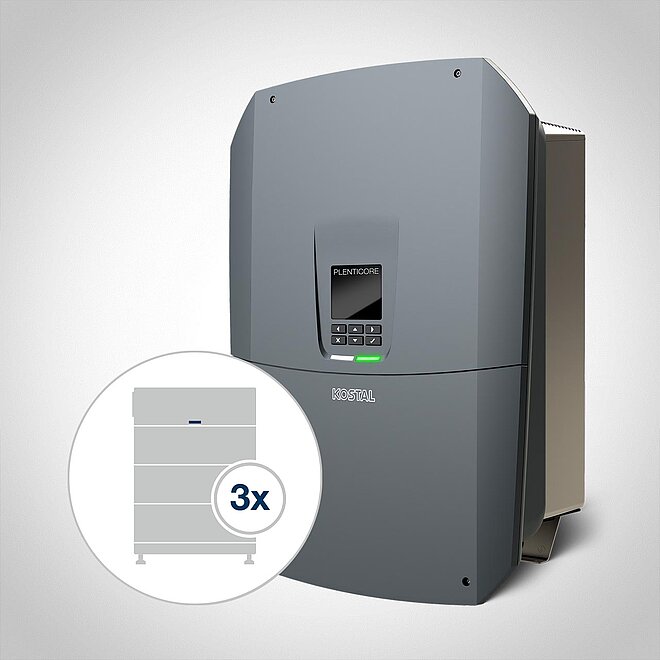
Once the battery function has been activated (subject to a charge), one of the PLENTICORE’s inputs becomes available for connecting a compatible battery storage unit.
What does the battery function enable?
- The third MPP tracker is used as a battery input.
- The inverter can store energy in a connected battery storage unit and release it again when required.
- The PV system and battery storage unit form a combined hybrid system.
- One compatible battery system can be operated per inverter; depending on the manufacturer, this may consist of several battery modules.
In short: the battery function enables a battery storage system to be operated with a single inverter.

Multi-Device Control –
intelligently connecting multiple devices
Multi Device Control (MDC) is included as standard in the PLENTICORE G3 and does not require any additional paid activation.
A PLENTICORE G3 acts as the MDC host, handling the central networking, visualisation and control of compatible devices.
What does Multi Device Control enable?
- Integration of further compatible inverters, such as the PLENTICORE G3 and PIKO CI
- Direct connection of the ENECTOR G2, including the supported convenience features
- Visualisation of additional loads and generators via compatible power meters, such as those from Shelly
- Centralised configuration via the MDC host’s device manager
- Joint visualisation and supported control functions within the network of devices
In short: MDC connects compatible devices to form a smart integrated system – as standard and free of charge.
Multi Battery Control –
control multiple battery storage systems simultaneously
Multi Battery Control is a paid add-on feature within Multi Device Control.
It enables the coordinated control of several PLENTICORE G3 inverters, each with a connected battery storage system.
One inverter acts as the MDC host, taking charge of the overall coordination. The connected client inverters remain independently connected to their respective battery management systems.
What does Multi Battery Control enable?
- Co-ordinated charging and discharging control of multiple battery systems
- Accounting for different storage capacities and states of charge
- Shared use of the available storage capacity across the interconnected system
- Centralised control via the MDC host
Important to note:
- Activating Multi Battery Control costs a one-off fee of 1 PLENTICOIN.
- The activation code is required exclusively on the MDC host.
- No additional Multi Battery Control activation is required for the client inverters.
- The necessary activations for the respective battery functions remain unaffected.
In short: Multi Battery Control coordinates multiple battery storage systems within an MDC network.
The difference at a glance
| Function | Task | Level | Inverter |
|---|---|---|---|
| Battery function | Operation of a compatible battery storage system connected to an inverter | Single device | Activation subject to a fee |
| Multi Device Control | Networking, visualisation and control of compatible devices | Entire system | Standard, free of charge |
| Multi Battery Control | Coordination of multiple battery systems within an inverter network | Entire system with batteries | 1 PLENTICOIN on the host |
Typical applications
Detached house with a battery storage system
A PLENTICORE G3 with a connected battery storage system.
The battery function enables the storage unit to operate. There is no need to activate the Multi Battery Control function.
PV system with wallbox and other devices
A PLENTICORE G3 with battery storage, KOSTAL Energy Meter and ENECTOR G2.
The battery function enables the storage system to operate. MDC handles the integration and control of the wallbox and other compatible devices – without the need for additional, chargeable MDC activation.
Larger PV system with multiple battery storage units
Two PLENTICORE G3 units, each with its own battery storage system.
MDC connects the inverters to form a single network of devices. Multi Battery Control handles the coordinated control of the connected battery systems.
To do this, Multi Battery Control is activated once on the host. The respective battery functions must be activated independently of this.
Conclusion: The right function for every requirement
The battery function activates the storage system. MDC connects devices. Multi Battery Control coordinates battery storage systems.
This allows KOSTAL PV systems to be set up flexibly and expanded as requirements grow – from a single battery storage unit to an intelligently controlled network of storage units.