
 Installer portal
 Solar Academy
 Download
 Solar Terminal

The SPI seal: This is how efficiency pays off – year after year.
Why efficiency in your solar system is worth its weight in gold: a closer look at the SPI seal
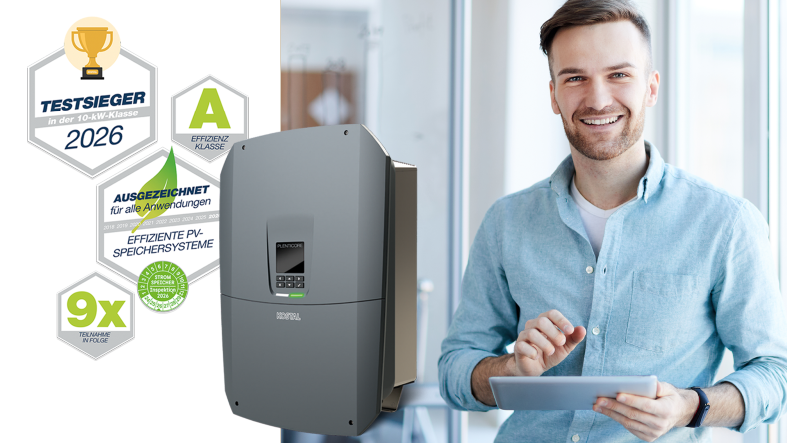
Anyone who decides to invest in a photovoltaic system today usually does so for two reasons: to protect the environment and to reduce their electricity costs in the long term. Yet while many prospective buyers meticulously compare the output of solar panels, one crucial component is often overlooked: the efficiency of the overall storage system. And it is precisely this interplay that determines whether your system is a sound investment or whether it wastes energy – and therefore money – unnecessarily.
A key guide through the jungle of technical data is the so-called SPI Label. But what exactly does it mean, and why should it be the most important purchasing criterion for every homeowner?
System Efficiency
What is decisive for the real-world performance of a PV system is how the inverter and battery work together. In addition, a highly efficient inverter should also perform well in standby mode, keeping energy consumption low and communicating optimally with the storage system.
This is where the System Performance Index (SPI) comes in. This label is awarded by HTW Berlin and evaluates the actual efficiency of a PV storage system under realistic annual operating conditions. Rather than measuring individual components in isolation in a laboratory, the SPI assesses the entire system as a unit – from energy generation on the roof, to storage in the basement, to consumption in the household.
What makes a System Truly Efficient?
A high SPI value is no coincidence – it is the result of intelligent engineering:
- Low conversion losses: Every time electricity is converted from DC (solar panels) to AC (household) or back into the battery, energy is lost.
- Excellent part-load efficiency: A solar system rarely operates at full load. In the morning and evening hours, or when overcast, the system must work efficiently even at low output levels.
- Minimal standby consumption: A storage system is active 24 hours a day. Excessive self-consumption by the devices, particularly at night, eats into yields.
- Intelligent control: Only when the inverter and storage are perfectly matched does the system extract the maximum amount of usable energy.
Small Differences, Big Impact
Even a difference of just a few percentage points in the SPI value has a measurable impact on annual energy yield. A look at the figures illustrates the financial impact:
Suppose you are comparing two systems. System A achieves an SPI of 95%, whilst System B is at 89%. At first glance, the difference seems small. But in practice, this means that System A delivers over 4,750 kWh of usable energy per year, whilst System B only manages 4,450 kWh.
At current prices, this difference of 300 kWh per year equates to annual savings of around €111. If we extrapolate this over a 15-year operating period – and without taking future electricity price rises into account – this results in a substantial saving of around €1,665 for the more efficient system. As a PV system is usually designed to last 20 years or more, the actual return on investment is often significantly higher.
| System comparison | Net output (kWh/year) | Savings (15 years) |
|---|---|---|
| System with 95% SPI | > 4,750 kWh | Reference |
| System with 89% SPI | > 4,450 kWh | - €1,665 |
Future-Proofing Through Compatibility
Another important aspect for end customers is flexibility. Modern top performers – such as the PLENTICORE by KOSTAL (2026 award winner in the 10-kW class) – offer broad compatibility with various battery manufacturers such as BYD, VARTA, and Pylontech.
This matters because your household’s needs will change over time. Someone buying a PV system today may be thinking about a heat pump or an electric vehicle tomorrow. An efficient system that can “grow” with you over time and is highly rated for all applications provides the security you need.
Ask for the SPI Label
A photovoltaic system is a long-term investment. It therefore makes sense to base the decision on reliable key metrics. And the return lies in efficiency.
Tip: When purchasing a PV system, specifically ask for the SPI Label. Also ask about the efficiency class and request a full explanation of the overall system performance. Only a system that has been independently tested can guarantee that you will still be getting the maximum out of every ray of sunshine 20 years from now. Because more usable solar energy in your own home means less expensive electricity drawn from the grid and a higher return on your investment.
Download the SPI factsheet now.