
 Installer portal
 Download
 Solar Terminal

MP Bettina Lugk visits KOSTAL in Hagen – Focus on industry, energy and regional strength
Bettina Lugk, a Member of the German Bundestag (SPD), visited KOSTAL Industrie Elektrik GmbH & Co. KG at its Hagen site to discuss current developments, challenges and prospects for the industrial location in North Rhine-Westphalia. KOSTAL is one of the leading suppliers of power electronics and develops innovative solutions for photovoltaic systems in Hagen.
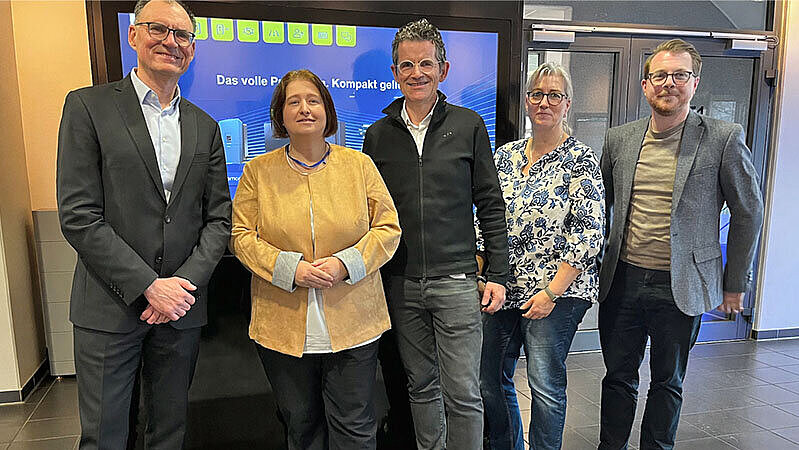
Those taking part in the discussion included Dr Manfred Gerhard (Managing Director of KOSTAL Industrie Elektrik), Frank Henn (Managing Director of KOSTAL Solar Electric) and representatives of the works council. The discussion
focused on key issues relating to industry and small and medium-sized enterprises, as well as the importance of regional value creation in North Rhine-Westphalia. In addition, the competitiveness of Germany and Europe as industrial locations was discussed at length.
Particular attention was paid to the current energy policy framework and its impact on the solar industry in Germany and Europe. Topics discussed included potential adjustments to subsidy mechanisms for smaller photovoltaic systems and changes to requirements for system operators. KOSTAL made it clear that these developments could pose challenges for domestic inverter production, meaning that the competitiveness of this stage of the value chain is becoming increasingly important.
“For us, it is crucial that the political framework is reliable and enables investment and innovation,” explains Dr Manfred Gerhard, Managing Director of KOSTAL Industrie Elektrik. “Only in this way can industrial value creation and skilled jobs be secured in the long term in Germany and Europe.”
The participants in the discussion also highlighted the tense market situation: following strong growth in recent years, the market for smaller rooftop photovoltaic systems is in significant decline. At the same time, international competitors have substantially expanded their market shares. Additional regulatory uncertainties could further exacerbate this trend and hinder investment in innovation and production. As the central control unit of modern photovoltaic systems,
inverters play a key role: They convert energy, control storage systems, enable grid services and ensure the operation of energy systems. As the ‘brain’ of the solar system, they are an integral part of a stable and increasingly decentralised energy infrastructure.
Against this backdrop, it was emphasised that inverter technology is increasingly being classified as part of critical infrastructure and can be further strengthened as a core industrial competence in Europe. A strong European industry is not only economically significant but also crucial for security of supply, technological sovereignty and resilience.
At the same time, the energy transition was highlighted as a key opportunity for Germany. The further expansion of photovoltaics makes a significant contribution to climate-friendly energy supply, to reducing geopolitical dependencies and to strengthening a resilient energy infrastructure. Modern storage solutions and smart energy management systems make it possible to use renewable energy efficiently and relieve the burden on grids. “The
energy transition is not only an ecological necessity, but also a key economic factor for our region,” emphasised Bettina Lugk. “This makes it all the more important that we keep an eye on industrial value creation, innovation and employment in Germany.”
During the discussion, it became clear that the transformation requires reliable and balanced political framework conditions. Support mechanisms should be designed to ensure market stability, facilitate investment and, at the same time, promote innovation. A functioning domestic
market is of particular importance in this regard. Without stable demand in their own market, it is virtually impossible for European manufacturers to hold their own in global competition. Past experience – for example in solar cell and module production – shows how quickly industrial value creation can be lost.
The visit underscored the importance of direct dialogue between politics and industry. Bettina Lugk showed great interest in the practical challenges on the ground and took away important insights for further political deliberations.